A thread gauge cannot tell you which standard is on the bench. It measures the pitch. Pitch is the one number NPT and BSP sometimes share.
So skip it. A digital caliper and a tape measure do the job, and you probably already own both.
Threads per inch counts the full threads inside 25.4 mm. Park the caliper at the start of a thread and count for a full inch. 1/2″ comes out at 14 whether it is NPT or BSP, on both standards.
BSP thread pitch runs 28 / 19 / 14 / 11 TPI from 1/8″ up to 1″. NPT runs 27 / 18 / 14 / 11.5. The math: 25.4 divided by 14 gives a 1.81 mm pitch. Take that number to the pairing chart.
Diameter is the faster read, when it is not a taper. A 1/2″ BSPP parallel thread measures 20.955 mm across the crests. NPT at the same size measures 21.34 mm. That 0.39 mm gap is easy money for a caliper. The port is the same size either way, so the caliper settles it outright.
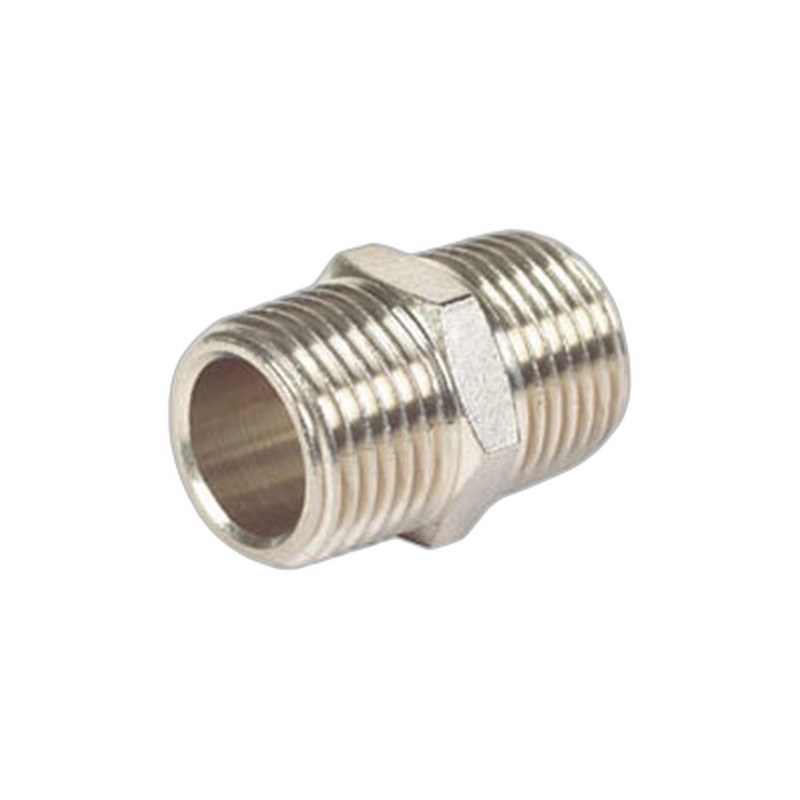
A tapered thread will not let you do this. NPT runs 1:16. Walk the caliper down the thread and the reading shrinks by about 0.05 mm per millimetre. Parallel BSPP holds one diameter to the end of the thread. Then confirm with pitch. NPT cuts a 60° flank and BSP cuts 55°. That is the whole difference, and calipers cannot see it.
Do not identify a thread by measuring the hex. A 5/8″ hex says nothing about the port size underneath it.
Now the part that decides whether a job goes smoothly.
Air compressor ports are almost always 1/4″ NPT female. That covers the tank outlet, the regulator inlet and the manifold. 3/8″ NPT shows up on high-flow kit, and 1/2″ NPT on bigger tanks and long runs. Filter-regulator units follow the same map.
ISO 6432 cylinders go the other way. A 20, 25 or 32 mm bore takes a G1/8 port. A 12 or 16 mm bore takes M5. At 40 and 50 mm it is G1/4, and at 80 mm, G3/8. Two families on one shelf, and only some part numbers offer NPT. Max working pressure is 0.7 MPa. Ambient tops out at 60°C.
Solenoid valves are where it bites hardest. The same valve body ships with G ports or NPT ports. If the listing does not say which, you do not know what you bought until it arrives.
Meters, litres, bar, G threads. Inches, gallons, psi and NPT. They look the same on a shelf.
Do not guess a thread by eye. Do not force a 5/8″ hex end into a 3/8″ port because the bag said it fits. Do not buy a fitting from a listing that never names NPT, BSP or G. And do not run NPT into BSP and paper over it with tape. The taper seals metal on metal under torque. Tape lubricates and fills pinholes. It does not make two different standards into one.
Three numbers and you are done. Threads per inch over 25.4 mm, crest diameter in mm, and whether the diameter shrinks along the thread. Send us those three. We will name the standard and hand you the part.
Our brass push-in fittings and brass connectors ship in NPT, BSPT and BSPP, which covers both families above. The pairing chart has every size side by side, and the mm chart handles the tube end if that is the number you are missing.