A valve with three boxes on it could be a directional valve, a pressure regulator or a sequence valve. Same shape. Same arrows. Three different jobs.
That is why “how many types of pneumatic valve” never gets a clean answer. There is no official count. What exists is four families and one drawing convention.
Start with the drawing. ISO 1219 gives each box one switching position. A 2/2 valve gets two boxes. A 5/3 gets three. Inside a box, a plain line is an open path, an arrow shows which way air travels, and a T means that port is blocked.
Ports count differently. The number before the slash is ports, the one after is positions. Pilot lines at 12 and 14 do not count, and neither does the coil.
Port numbering sits in a different standard, ISO 11727. Port 1 is supply. 2 and 4 feed the cylinder. 3 and 5 exhaust. If you also see P, A, B and EB, those are letters laid beside the numbers. Letters are the hydraulic habit.
Now the four families.
Directional valves route air and decide which way a cylinder travels. This is where 5/2 and 5/3 live. A 5/2 has two separate exhaust ports, so you can throttle each direction on its own. A 4/2 shares one exhaust. Both directions then vent through the same restriction, and you lose that adjustment.
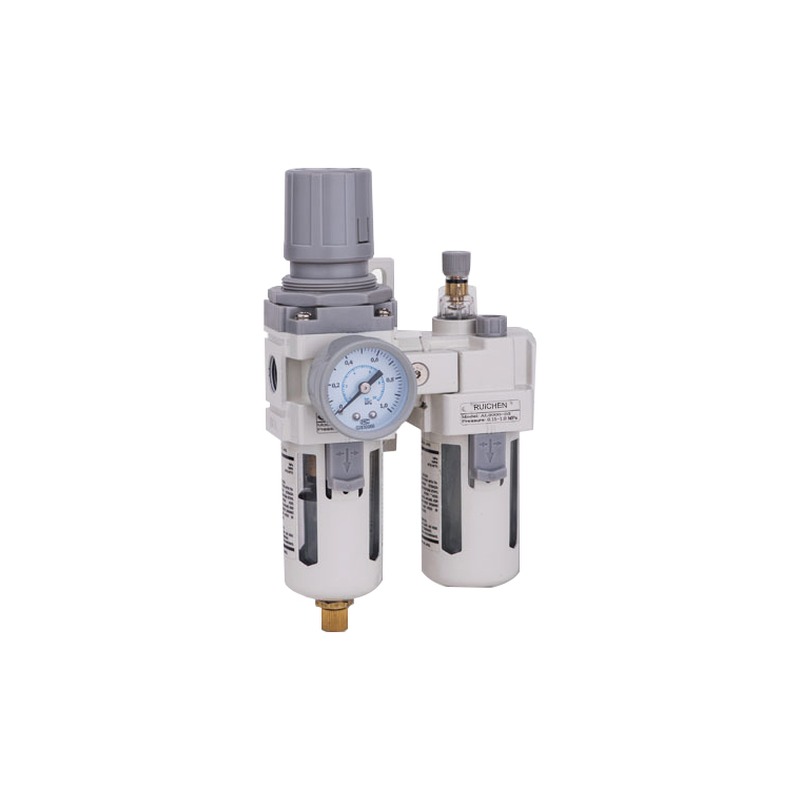
Pressure valves set or limit pressure. Your filter regulator belongs here. A set range of 0.05 to 0.85 MPa is common on an AR unit, with 1.0 MPa max working pressure and 1.5 MPa proof. A sequence valve shares the family and looks like a two-box directional valve on paper.
Flow control valves change speed, not direction. Most are one-way throttle valves: free flow one way, a needle restriction the other. Fit them to restrict the exhaust, close to the cylinder port. Meter-in lets air build behind the piston, and the piston surges the moment the load lightens.
Check valves pass air one way and block it the other. The pilot-operated version unseats on a signal. It is the closest pneumatics gets to a leak-free hold.
Here is where people go wrong. They read 5/3 and assume it holds position. Closed centre traps air on both sides of the piston, which sounds like a lock. A spool seals on machined clearance, trapped air bleeds past it, and ISO 4414:2010 wants unexpected movement stopped by design. Treat it as a pause counted in minutes. If a hand can reach under the load, fit a rod lock.

The other mistake is ordering on the symbol. Flow lives in the datasheet. The same 5/2 function runs about 400 l/min at an M5 port. At 1/2 inch it moves roughly 2500 l/min, with Cv climbing from 0.40 to 2.50. Your drawing will not tell you which one is on the shelf.
Count the boxes. Name the family. Then check flow and port thread before you buy. Our directional and solenoid valves list flow for every body size. The FRL units cover the pressure side.