Your compressor gauge reads 8 bar. The tool at the far end of the line runs like it is on 5. Nobody stole the difference. The tube ate it.
Air loses pressure the whole way down a line. Not because the tube leaks, because the air rubs against the wall. Every metre costs you something. Most shops find out the hard way, when a new machine at the end of a long run will not develop the force it was sized for.
Why length costs pressure
Think of it as drag. Air moving through a tube scrapes along the inner surface. The longer the run, the more surface there is to scrape against. That drag shows up on your gauge as lost pressure.
The surprise is how fast it adds up. Ten metres of small tube is often fine. Thirty metres of the same tube is not. Double the length and you roughly double the loss.
The other factor: bore size
Bore does more than length, and it does it harder. Pressure loss does not scale with diameter, it scales with diameter to roughly the fifth power. Halve the bore and the loss climbs by about thirty times.
That is why feeding an 8 mm tool through 6 mm tube is not a small compromise. It is a large one, hiding behind a fitting that looks correct.
| Tube OD | Loss at 10 m | Loss at 30 m | Loss at 50 m |
|---|---|---|---|
| 4 mm | 0.5 bar | 1.5 bar | 2.6 bar |
| 6 mm | 0.2 bar | 0.7 bar | 1.2 bar |
| 8 mm | 0.1 bar | 0.3 bar | 0.5 bar |
| 10 mm | 0.05 bar | 0.15 bar | 0.25 bar |
| 12 mm | 0.03 bar | 0.09 bar | 0.16 bar |
Read the 4 mm row against the 12 mm row. Same line, same length, a different machine. Upsizing is the cheapest fix most shops never make.
Bends and fittings count too
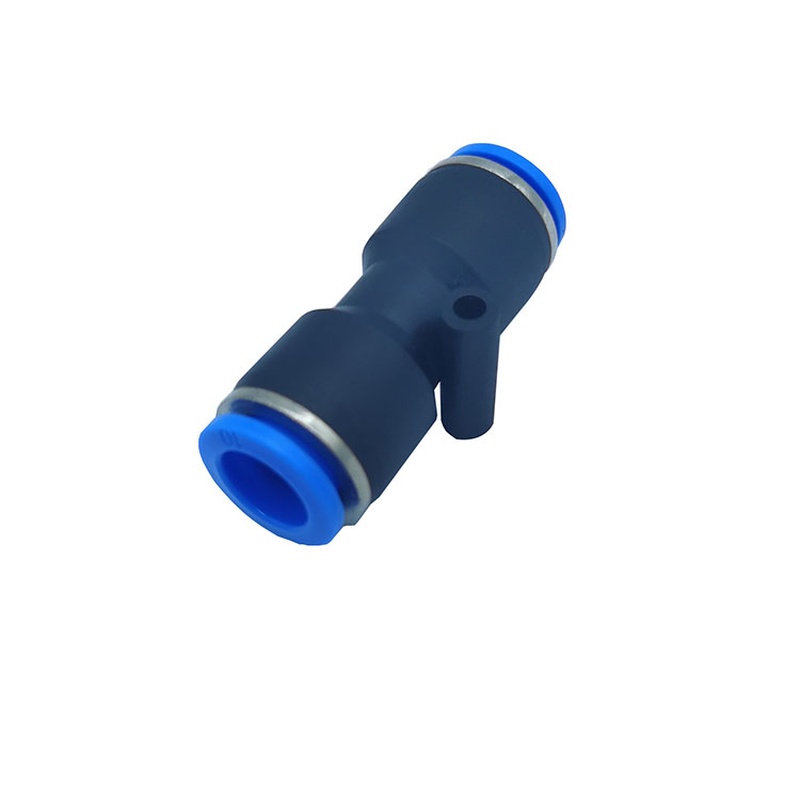
A sharp bend behaves like extra straight tube. A kinked 90 degree turn in a 6 mm line can cost as much as two or three metres of the same tube. So does every push-in fitting, ball valve and quick coupling on the run.
Keep the bend radius at ten times the tube OD or more. Route long lines in gentle arcs instead of right angles. It costs nothing and it buys you pressure.
Material matters less than you think
PU and nylon sit close together on pressure loss. Nylon holds its dimension better, which matters on a hot line. PU bends tighter, which matters where space is short.
What matters far more than material is bore and length. Pick the size first, then the material.
What to do about it
Three moves, in order of value.
Upsize the main run. Going from 6 mm to 8 mm on a thirty metre line recovers most of the loss for cents per metre.
Shorten the path. If the line wanders, reroute it. Every metre removed is pressure kept.
Feed branches at the source. Splitting into two short branches at the compressor loses far less than running one line past the first machine to reach the second.
Measure before you buy. Put a gauge at the tool end and read it while the tool is running. That number, not the compressor gauge, tells you whether the tube is big enough.
Send us the line length, the tube OD you are running now, and the pressure you read at the tool. We will tell you what to change, and quote the tubing if a change is needed. Our PU vs nylon guide covers the material choice once the size is settled.
Related guides
- Air hose sizes and fitting codes: how OD and ID get named differently.
- Pneumatic fitting size chart in mm: the metric to inch table, and the 0.35 mm gap.
- PU vs nylon air tubing: which material fits your machine.
- Browse the air tubing range: PU, nylon and PE, 4 to 16 mm.