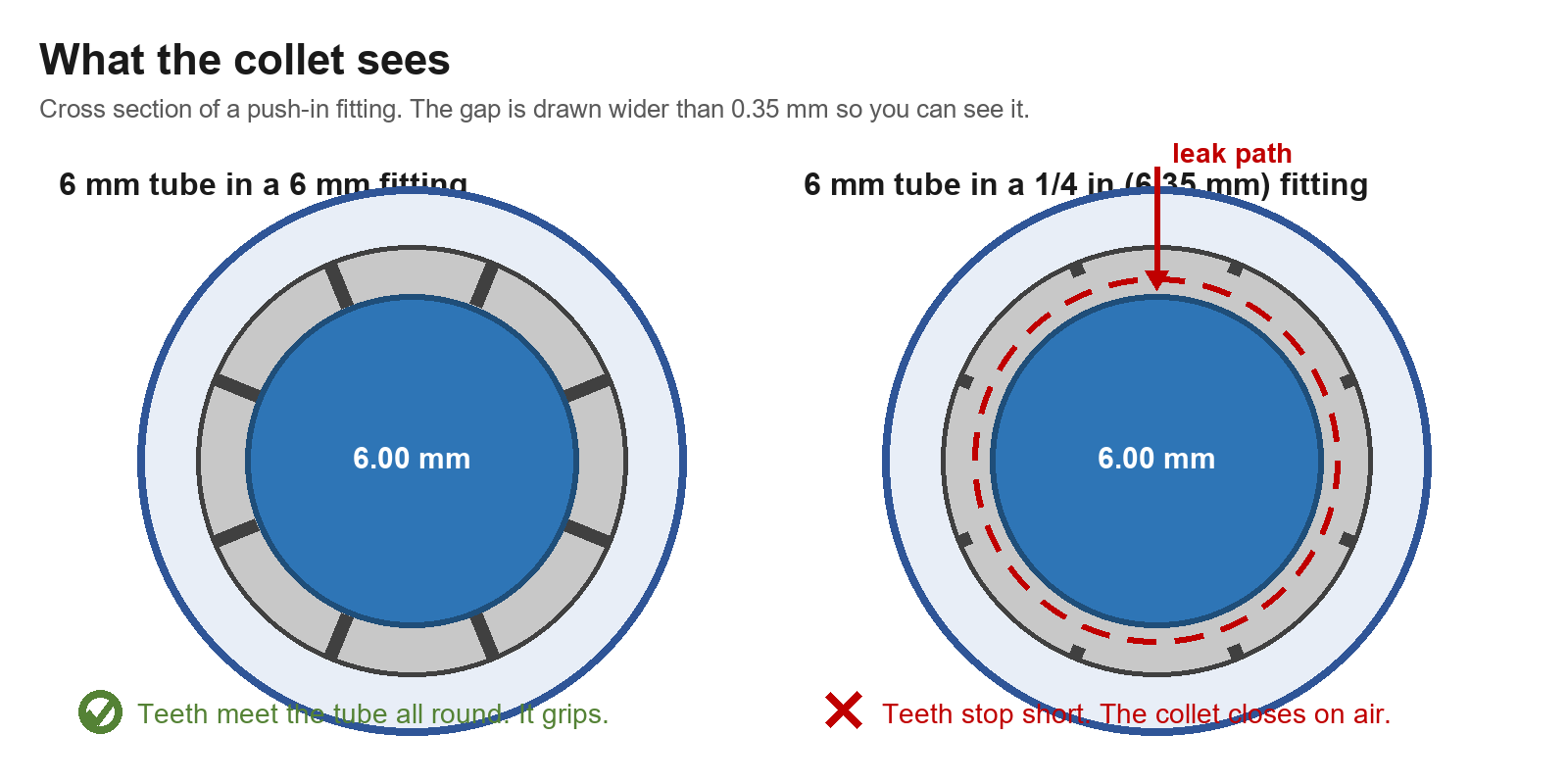
A 6 mm tube and a 1/4 inch tube are not the same size. The gap between them is 0.35 mm. That is enough to keep a collet from biting, and enough to start a leak.
Two tubes sit on the bench. Calipers read 6.00 mm on one and 6.35 mm on the other. The labels say 6 and 1/4, and both are honest. The two parts still do not belong in the same machine.
A push-in fitting grips the outside of the tube, not the bore. ISO 14743:2020 covers push-in connectors for thermoplastic tube from 3 mm to 16 mm outside diameter, inch sizes included. The standard tests the connector and the tube as one assembly, so the tube has to hold its OD within about 0.1 mm. The O-ring and the collet are cut for one number. Six means 6.00 mm. A quarter inch means 6.35 mm.
Metric tube runs 4, 6, 8, 10, 12 and 16 mm. Inch tube runs 1/8, 5/32, 1/4, 5/16, 3/8 and 1/2 inch. Two catalogues, not one with two spellings.
Here is the chart people search for. The gap column is the part that matters.
| Metric tube | Nearest inch tube | Inch size in mm | Gap |
|---|---|---|---|
| 4 mm | 5/32″ | 3.97 | 0.03 mm |
| 6 mm | 1/4″ | 6.35 | 0.35 mm |
| 8 mm | 5/16″ | 7.94 | 0.06 mm |
| 10 mm | 3/8″ | 9.53 | 0.47 mm |
| 12 mm | 1/2″ | 12.70 | 0.70 mm |
| 16 mm | 5/8″ | 15.88 | 0.12 mm |
Three rows carry real risk: 6 mm, 10 mm and 12 mm. Force a 1/4 inch tube into a 6 mm fitting and the collet cannot bite all the way round. Drop a 6 mm tube into a 1/4 inch fitting and the collet closes on air. We have seen both. The second one seals fine on the bench and leaks the first time the line sees real pressure.
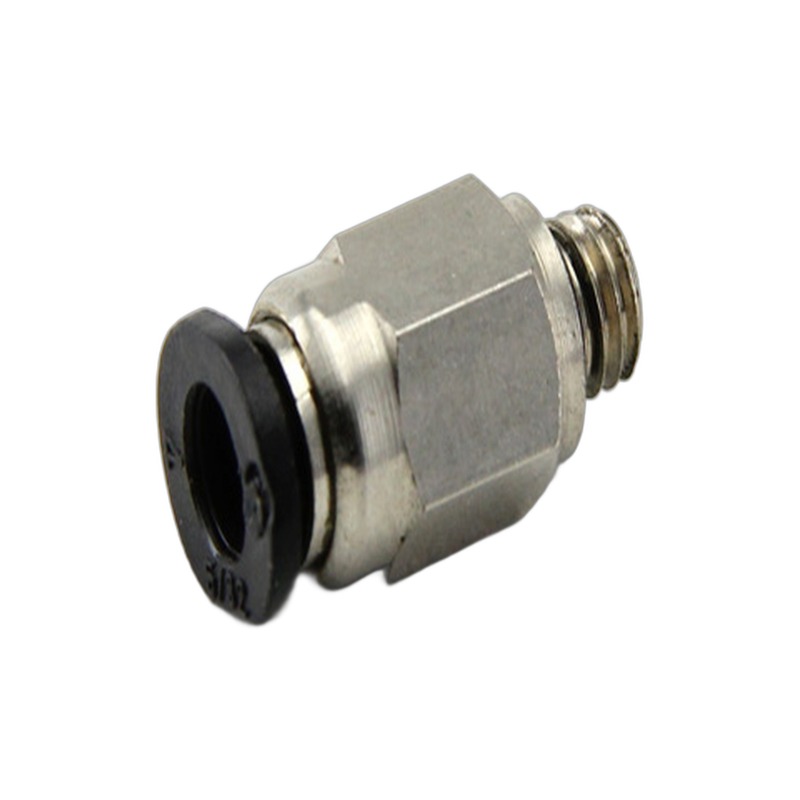
The small gaps are not a free pass either. A 5/32 inch tube inside a 4 mm fitting sits 0.03 mm under nominal. That is inside the tolerance band, so it may go in. The standard still tests the tube and the fitting as one assembly, and that test ran on one size. Out-of-round tube or a scratch on the sealing surface puts you outside it. Do not build a plant on a near miss.
The full size table
OD is the number the collet reads. ID is what sets the flow. Wall thickness is what sets the pressure and the bend radius. Buyers usually only check the first one, then wonder why the tool runs slow.
| Tube OD (mm) | Typical ID (mm) | Nearest inch OD | Min bend radius (mm) | Approx. flow at 6 bar (L/min) |
|---|---|---|---|---|
| 4 mm | 2.5 | 5/32″ (3.97) | 10 | 25 |
| 6 mm | 4.0 | 1/4″ (6.35) | 15 | 60 |
| 8 mm | 5.0 | 5/16″ (7.94) | 20 | 110 |
| 10 mm | 6.5 | 3/8″ (9.53) | 27 | 180 |
| 12 mm | 8.0 | 1/2″ (12.70) | 35 | 270 |
| 16 mm | 12.0 | 5/8″ (15.88) | 60 | 500 |
Read the bend radius column before you plan the routing. Bend a 4 mm tube tighter than 10 mm and it kinks, and a kink costs you more pressure than a whole metre of extra length.
The flow column is the reason a bigger tube is often cheaper than a bigger compressor. Going from 6 mm to 8 mm roughly doubles the air you can move. It costs a few cents per metre.
The three mismatches we see most
6 mm tube into a 1/4 inch fitting. The collet closes on air. It holds on the bench and leaks under load. This is the most common single failure we get asked about.
12.7 mm ordered as a catalogue number. No catalogue lists it. You will be shipped a 12 mm fitting or a 1/2 inch one, and you find out which when the tube does not seal. Order by the family name, not the decimal.
Barb sized to the thread. The barb follows the hose bore, never the thread. A 1/4 NPT coupling can carry a 6 mm barb or an 8 mm barb. If you order by thread alone you have a fifty percent chance of a return shipment.
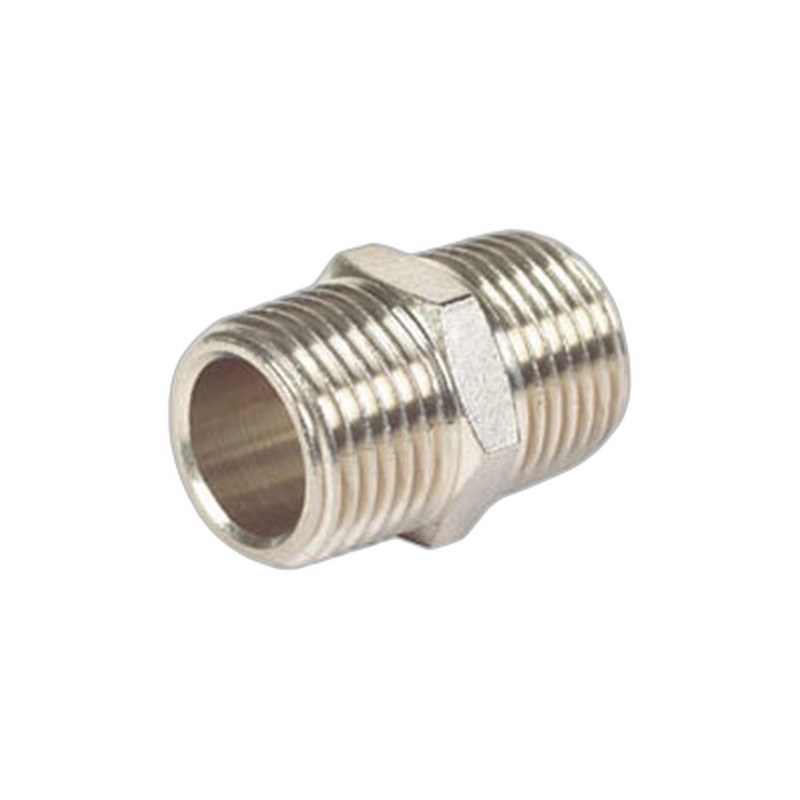
The thread on the other end is a separate row. The same 6 mm tube takes a G1/8 thread or a G1/4 thread. Tube size and port thread never talk to each other. Write both down before you order.
Read the marking on the tube and buy that exact family. Send us the number on the tube and the thread on the port. We will match it in one reply. Our brass push-in fittings and plastic push-in fittings cover 4–16 mm tube with R, NPT and G threads. Working from a caliper reading instead of a label? Our measuring guide walks through it.
Related guides
- Which push-in fitting do you need: the PC, PL, PE, PU letter codes, decoded.
- Brass vs plastic push-in fittings: when to use metal, when plastic wins.
- Air hose sizes and fitting codes: how OD and ID get named differently.
- Identify a pneumatic thread without a gauge: the caliper trick that reads a thread in ten seconds.