A 50 mm bore on a 100 mm stroke sweeps 0.196 litres on the extend. Your compressor doesn’t see 0.196. At 6 bar that one movement takes about 1.36 litres of free air. Count both strokes and it’s 2.71 litres. Swept volume and compressor load are not the same number.
SCFM is the correction. It converts air at working pressure back to free air at atmosphere, so a compressor rating and a tool demand can be compared at all. The reference state isn’t universal, though. ASME uses 14.7 psia and 68°F. CAGI uses 14.5 psia and 60°F. ISO 1217 uses 1.0 bar absolute and 20°C. That spread runs about 5%, enough to matter when you match a European FAD plate against an American SCFM number.
Two formulas do the work. Inches first: CFM = (piston area × stroke × cycles per minute) / 1728. Then SCFM = CFM × (gauge pressure + 14.7) / 14.7.
Working in metric? Convert once at the end. One SCFM is about 28.3 NLPM. Run the volumes in litres, divide by 28.3, and keep every step inside one unit system. Switching mid-calculation is the mistake I see most.
Here’s a real one. 2 inch bore, 4 inch stroke, 30 cycles a minute, 80 PSI, 5/8 inch rod. Piston area is 3.14 in². It’s double-acting, so both strokes count: 2 × 3.14 minus the 0.31 in² rod area leaves 5.98 in². CFM = 5.98 × 4 × 30 / 1728 = 0.415. SCFM = 0.415 × 94.7 / 14.7 = 2.67.

That 2.67 is one cylinder. Add the rest the same way, then stop before you sum the whole plant. Ten cylinders rarely fire together. A 0.65 to 0.85 simultaneous use factor lands closer to the truth than a straight addition.
Then add the losses nobody draws. Leaks eat 10 to 30% of output in a plant that’s a few years old. A dryer purge takes another 5 to 15%. Duty cycle wants 1.5 to 3 times the steady figure. Turn 2.67 SCFM into a compressor spec and you end up somewhere past 5.
Don’t trust the nameplate alone. Put a flow meter on the receiver and log a full shift. I’ve watched a compressor sold as 20 SCFM deliver 14, because three drops had never been repacked. Fix the leaks first. They cost less than iron.
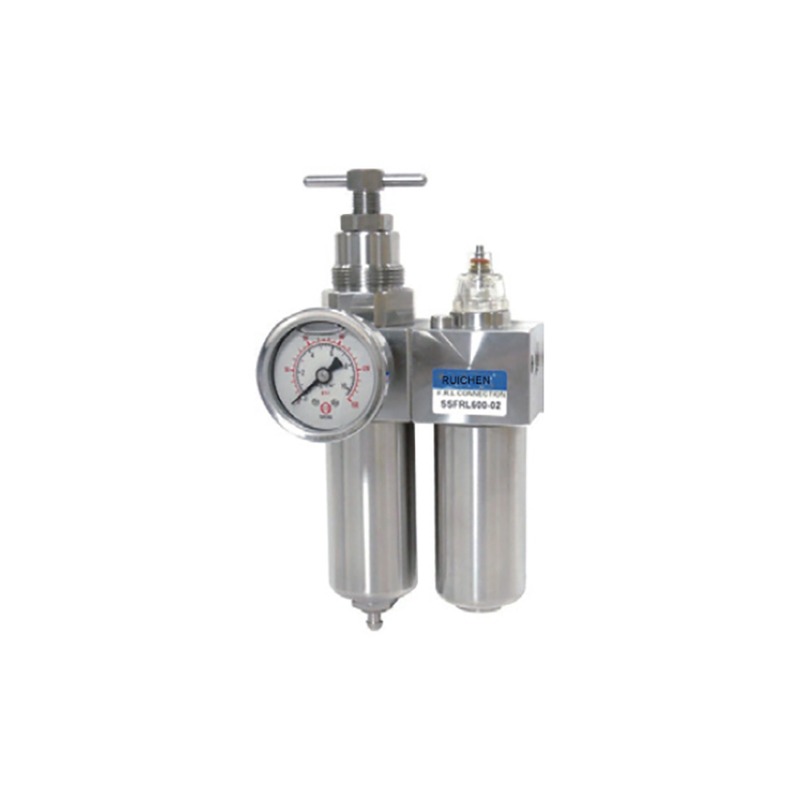
The air doesn’t stop at the compressor either. It goes through your regulator, and a setpoint left 1 bar too high inflates every number in this article. Start at the FRL, then work through what the cylinders actually pull.